 English
 Español
 Italiano

Crank arm length is an important factor in the relationship between a cyclist and their bike. The impact of crank arm length on bio-mechanical function, power output, and performance has been the focus of quite a bit of attention and research over the past few years, both informally and anecdotally in the fit studio, and scientifically in the research lab. Bike fitters should evaluate the appropriateness of crank arm length in their assessment of the rider and their bike, and either confirm the suitability of a selected crank length or make a recommendation for a different length. Such a recommendation may be a “soft recommendation”, where the current crank may be satisfactory, but a different length may be more optimal, or a “hard recommendation” whereby a change of crank length is assessed as essential to overcoming a particular complaint or functional limitation. Increasingly, cyclists are more conscious that crank length can impact function and performance and are asking their fitter if their crank length is appropriate.
Media Attention
Since this blog post was first published in 2024 there has been an enormous increase in attention to the topic of crank length. We can thank one man for that: professional rider and multiple Grand Tour winner Tadej Pogacar, and the attendant cycling media focus on his change from riding a crank length of 172.5 to 165mm. The unwavering focus and reporting on one pro rider has done more to influence the conversation on crank length than the combined effort of hundreds of bike fitters over the past decade. Go figure.
There have been many benefits to this attention:
- cyclists are now aware that crank length is not fixed, and different options exist
- cyclists are asking their fitter and bike shop about crank length, and what might be appropriate for them
- component manufacturers, feet dragging as always, are starting to offer more length options to meet demand
- bike fitters are having an easier time successfully advising their clients to change to a different length, when warranted
There have also been some unintended consequences:
- some cycling pundits now view shorter cranks as a trend or fad, not a legitimate consideration in cycling comfort and performance
- some cyclists are changing crank length simply to imitate pro riders, without consideration as to what is best for their own needs
- inventory shortages of some crank lengths due to the above lemming-like behaviour have made it harder to find shorter cranks for those who genuinely need them!
- too many people now define a short crank as having a length of 165mm, and this length has been called this “teeny”. It is neither teeny, nor short. It is simply one of many length options.
Hence a revisit on this topic with updates where needed.
Why is Crank Arm Length Important?
The majority of cyclists use cycling shoes with cleats that attach to a pedal. With the pelvis jammed on a saddle at one end of their legs, and their feet mechanically attached to the pedals at the other end of the legs, the bio-mechanical gait action of cycling is then largely defined by the (slightly elliptical) circle that the legs move through to deliver force to the pedals. The length of the crank arms determines the diameter of that circle. For the hip and leg muscles to contract through their optimal range to generate force, the diameter needs to be appropriate. Not too big, not too small. If the circle is too big, the knee and hip joints are forced through a larger flexion range than they may like whilst attempting to generate force. This can aggravate muscles, tendons, and ligaments as well as compress arterial blood supply and impinge on nerves. In addition, the pedal stroke can feel lumpy rather than fluid, and there may be a delay in force applied during the power phase of the stroke. Common symptoms of a crank that is too long are pain in the hip joint or nearby muscles (often on one side only), knee pain, and riding uphill seems unreasonably hard. A crank arm too short is far less common and has less downside. The sensation can be that the pedal stroke is over too quickly, and the cyclist was only just starting to get a good push. This will be more obvious to cyclists who prefer a low cadence.
What is Worse – a Crank Too Short or a Crank Too Long?
A crank arm too long is worse than one too short. A crank too short may result in a loss of performance (although research argues this is rarely the case) but is highly unlikely to cause any harm. A crank too long is a common cause of low-grade injury and futile trips to a physical therapist for relief. Futile because it seems to be a body issue, not a bike issue, but the PT makes little progress because every ride sets back any progress made from the therapy. When a crank is too long, pedaling forces are shifted out of the muscles and into the joints. Although these forces are relatively low, the repetitive nature of pedaling serves to magnify the impact, literally.
Why Does a Bike Come with a Particular Crank Length, and What are the Options?
Unless you are on a Strider, every bike comes with a crankset, featuring a particular crank arm length. Why this is what it is can be attributed to a mix of tradition (i.e. that’s the way it’s always been), manufacturing cost control, economy of scale, and a bizarre dance between the demand from bike brand product managers who specify the parts on a bike, and the supply options from component manufacturers. Bike fitters and cyclists alike don’t get a say in the matter, unless taking a “fit-first” approach to buying a new bike, which involves selecting a frame and then the various components, including the crank set.
Focusing our attention on adult road, gravel, mountain, and tri bikes, up until recently there were usually 4 common sizes available from the dominant suppliers (Shimano and SRAM):
- 165 mm
- 170 mm
- 172.5 mm
- 175 mm
That’s a tiny 10mm difference between shortest and longest, to suit riders whose legs may vary in length by 200mm! Do you see the potential for inequity here? My inseam is 88cm and on my road bike I installed 170mm cranks. I see cyclists in for a fit who are on the same crank length with legs 10cm shorter than mine. Relatively to me, they are turning a much larger circle, subjecting their joints and attending muscles and ligaments to a larger range of motion and forces. Why aren’t there more options? Product managers aren’t demanding them from the component suppliers (they are not bike fitters and aren’t thinking deeply about fit), and component manufacturers are not offering them due to perceived low demand and high production costs (i.e. poor ROI). Product managers try and do their best with what they can acquire and will generally scale the crankset to the bike size: smaller bikes will have shorter cranks and larger bikes will have longer cranks. Although this is conceptually a good idea, the biomechanical reality is there is frequently a misalignment between what is supplied on the bike and what would be optimal for the rider. This is especially pronounced at the smaller end of the bike size range. That’s because the crank arm size range available does not cater to the range of body types that actually want to ride a bike comfortably and effectively. The crank arms are not scaled down proportionally to match the frame size, or the cyclist on that frame size.
Sensing a market opportunity, both Shimano and Sram have introduced 160mm cranks into their main road groupset offerings in the past couple of years. But Shimano still only goes down to 170mm in their GRX (gravel) series, which is an inconsiderate decision.
The most recent exciting news in crank length land is that Sram have introduced sizes down to 150mm in their Red (top level) cranksets, so these are now available in 150, 155, 160, 165, 167.5, 170, 172.5, and 175 mm length. I expect this is to further test market demand, and if it is there, we are likely to see these size options roll down to the Force level cranks as well, and maybe into Rival, which would be great news.
What is a Good Size Range for Cranks?
I’d suggest at least 155mm to 175mm in 5mm increments, and even better would be 145 mm to 185 mm. The most common default size in the market is 172.5 mm for no apparent reason, and although I’m sure it has its fans it’s sincerely a useless non-size in that a 170 or 175 would likely provide a better alternative for the cyclist.
With the Sram 150mm to 175mm options outlined above, we now have a very acceptable range from one of the dominant players in the market, and the other is likely to follow but this might take a few years.
Fortunately, several other smaller brands offer a wider range of lengths. These include:
- Croder Cycling, for which Fit Kit Systems is a USA dealer. You can see our Croder offerings here
- Appleman Bicycles
- Zinn
- JCOB Cycling
- Rotor
For mountain bikes and single chainring gravel bikes, Canfield Bikes and 5DEV offer a great selection of shorter crank options.
Speaking of mountain bikes, it seems that I’m not the only one examining the importance and value of shorter cranks. See the video below from Berm Peak.
In addition, there are a few cottage industry machinists who can take an existing alloy crank and turn it down in size. I have a client who had a 130 mm and a 135 mm crankset constructed to suit his uncommon dimensions due to a form of dwarfism. Check out Bike Smith Design if you need something custom or customized.
Unfortunately, cranksets are neither cheap nor “plug and play.” Other than buying a new bike, buying a new crankset is one of the more expensive fit-related equipment changeouts available. This is often compounded by the dizzying number of bottom bracket (frame shell, bearings and axle) variations which can make for a component and labor-expensive swap. This added expense often serves as a disincentive for a bike fitter to strongly recommend a different potentially more optimal crankset, and a disincentive for the cyclist to enthusiastically embrace the idea that another crank length could be that much better – unless they experience significant pain.
A simpler and cheaper alternative can be a crank arm shortener. These bolt onto the existing crank in place of the pedal, and provide a number of length options for mounting the pedal to that is shorter than the original. A potential disadvantage is the increase in stance width. However, these are a popular solution for use on stationary exercise bikes with non-changeable cranks. For temporary crank length shortening to aid in rehab after knee or hip surgery, a Swing Crank is a useful device. Below is a quick overview of what crank arm shorteners are and their use cases:
What Factors Influence Crank Length Choice?
There are a lot of reasons a rider (and a bike fitter) might want to evaluate and consider the most appropriate crank length. These are some general themes, and one aspect may be the primary driver, but they are all inter-related. In some cases the primary driver may be to resolve persistent aches or discomfort, and in other situation it is to explore potential performance gains. Pain is always the bigger motivator unless a cyclist is being paid to ride – in which case performance gains are the motivator. Although the pro teams are evaluating crank length for performance gains, the benefit for recreational enthusiasts is likely to be in improved biomechanical function and injury prevention.
Proportionality
- Leg length
- Existing crank length
- Bike frame size
Biomechanical Function
- Hip and knee range of motion and alignment
- Pelvic stability
- Existing pain / discomfort: butt, knees, hips, lower back
- Injury prevention
- Post injury / post op rehab needs
Performance Objectives
- Aerodynamics
- Force production
- Cadence preference
As a Cyclist, How do I Know if my Crank Length is Wrong for me?
As a default, it is my opinion that the vast majority of bikes are equipped with crank arms that are too long to be optimal for the person who will buy and ride that bike. Note the word optimal. Just because they may not be optimal doesn’t mean they are a problem. The human body has a wonderful capacity to accommodate and work around something that is not quite right. Many cyclists are happily riding a sub-optimal crank length without any adverse effects. They are also usually average or above average height. But when that capacity to make do is pushed too far, the body will speak up with aches, pains, inflammation, and aggravation. Some people will be more predisposed to the adverse effect of the wrong crank length due to any number of factors like aging, previous injuries, osteoarthritis, muscle strength and flexibility, riding position and intensity, or just a greater mismatch from the beginning. Here are some signs that your crank arm length is too long or wrong:
- You have recurring knee pain and all other aspects of your bike fit (cleat position, saddle position, etc) have been checked off and ruled out as a cause.
- You have recurring aches in the front or sides of one or both hips (often only one side)
- Bodywork (massage, chiro, PT, acupuncture, etc) for any of the above has not resulted in sustained relief.
- You can keep up with friends on flats but fall significantly behind on hills even though you seem to be of similar fitness
- The pedal stroke feels lumpy or sticky when getting your foot over the top of the stroke, rather than smooth and fluid
- If you try and pedal with one foot only, it’s difficult to get the foot over the top of the stroke
- You feel like you should be turning the pedals faster, but have trouble sustaining a cadence in the 80’s or 90’s, and anything over 100 is out of the question.
If you think a different crank length may be beneficial but are reluctant to incur the cost without more proof of concept, find a bike fitter who uses a Fit Bike with an adjustable crankset, or has the rideable Croder Spirit Crank Fitter. With either tool, bike fitters can provide you with the opportunity to easily test different crank lengths. Often the difference is immediately noticeable.
As a Bike Fitter, How Do I Assess Crank Length Suitability for a Rider?
There are several layers of information to gather as a bike fitter to determine if a recommendation for a different crank length is appropriate, and how strong a recommendation this should be.
Rider reported symptoms: In your rider interview, reported issues of knee or hip pain/ tightness or loss of power under heavy force demand (hills, seated intervals) should be considered a flag for examining crank length. Hip impingement is one of the most common symptoms, but these can include knee pain, lower back pain, saddle discomfort, and overworked quads (quad dominance), and difficulty and discomfort riding in the drops or in aero on a tri bike.
Fitter-observed signs: as well as what the rider reports, the fitter may observe things like pelvic instability, lower cross syndrome, tight knee and hip flexion angles.
Inseam length measurement: A static inseam measurement will provide a quick reference point for comparing leg length to crank length. Use the Inseam Measuring Device from Fit Kit Systems for a professional “non-invasive” approach to gathering this data, as compared to the old “book between the legs and back up to the wall” DIY technique. Anyone with an inseam length under 80cm (800mm) is almost always going to be on a crank too long, and the shorter their legs, the more significant the disparity. To draw from and simplify the recommendations made by cycling coach and bike fitter Rick Schultz, I offer the following guidelines for a starting point to evaluate inseam length to crank length.
| Inseam Length – centimeters | Recommended Crank Length |
| Under 75cm | 150mm or less |
| 75 – 79 cm | 155mm |
| 79 – 82 cm | 160mm |
| 82 – 85 cm | 165mm |
| 85 – 89 cm | 170mm |
| 89 – 94 cm | 175mm |
| Over 95cm | 180mm if preferred |
Some comments on this chart:
- Inseam length is one of several factors that influence the selection and recommendation of crank length. It is not the only factor. However skeletal length provides a baseline for a recommendation, and injury history and soft tissue factors are then overlayed on this.
- Most cyclists are probably on a crank too long, but most can get away with it. The shorter the inseam, the greater the mismatch is exaggerated, and the greater the physical cost and consequence.
- The above guideline would apply primarily to road and gravel bikes, and secondly to mountain bikes. Mountain bike brands have been slow to offer size appropriate cranks on their extra small and small frame sizes, to the detriment of their customers’ riding experience.
- For TT and Tri bikes, I would suggest subtracting an extra 5 – 10 mm of crank length to keep the hip flexion in a reasonable range (not too closed off)
Let’s take a closer look at inseam lengths:

Sample of cyclists’ Inseam Length. Source: Fit Kit Studio data
Note that from this random sample of nearly 400 cyclists, the highest frequency of inseam length is between 83 and 85 cm. My recommendation would place them on a 165 mm crank, or up to a 170 mm crank. The most common crank length is 172.5 mm. 175 mm is also a very common length, especially on mountain bikes. Look how common it is for an inseam length to be under 80cm! Below is a distribution of inseam length by gender, in relation to body height. There are a significant number of adult cyclists with an inseam length under 80cm, and the majority are women, who are not as well catered to by the bike industry as taller, male cyclists.

Height to Inseam by gender. Source: Fit Kit Studio data
Movement Assessment off the bike: This can be passive movement assessments on a treatment table, to evaluate knee and hip range of motion, or dynamic movement assessments like the Functional Movement Screen. Limitations in ROM and/or poor scores for knee and hip movements in the FMS can be indicators to pay close attention to the relevance of crank arm length.
Knee angle at maximum flexion and commencement of power stroke: Assessing how flexed the knee joint is at the top of the stroke at maximum flexion is a common method of assessment, either via hand-held goniometer, video analysis or 3D motion capture. A general guideline is that this should be greater than 70 degrees. Less than 70 degrees can be problematic for the rider. An additional assessment is to measure the knee angle at the commencement of the power stroke, which is when the crank arm is in line with the downtube. Close to 90 degrees is ideal. Many shorter-legged riders will be under this. Under 80 degrees is a red flag as the vector forces transmitted into the knee during attempted leg extension through the primary power phase will not be well received, and result in excessive joint loading. This can result in either symptoms of knee pain, or reduced and/or delayed force transfer to the pedal.
Hip flexion at top of stroke: In addition to knee flexion, hip flexion at the top of the stroke can be an indicator of crank length problems. This is going to be more relevant to athletes on a Tri or TT bike riding in an aero position. Aim for a hip flexion angle of greater than 45 degrees.
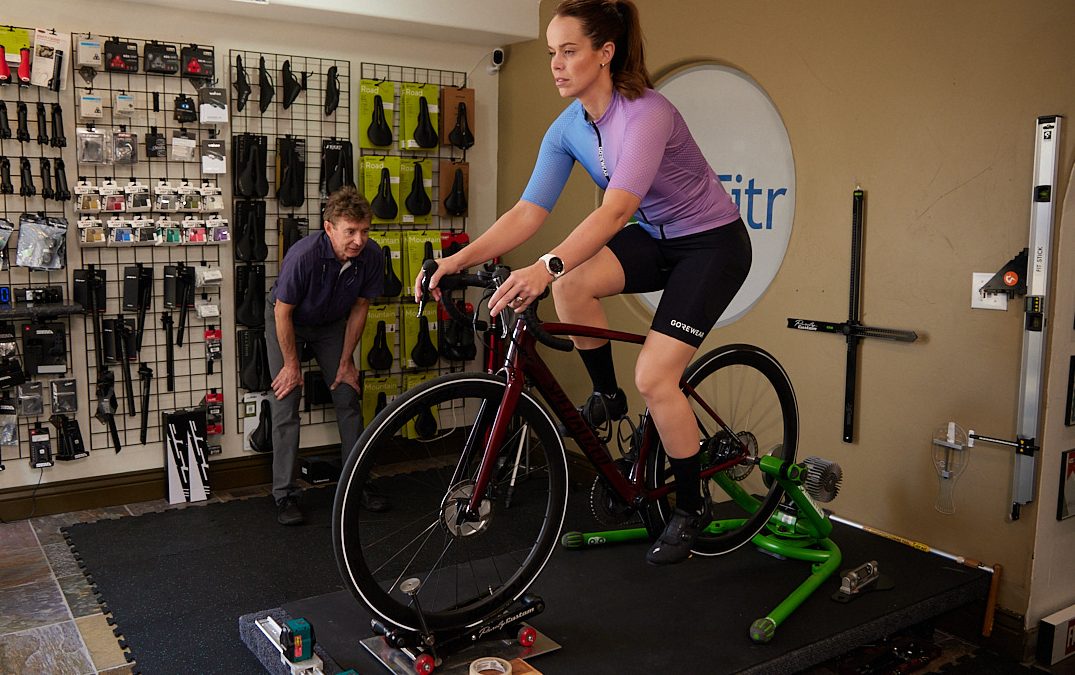
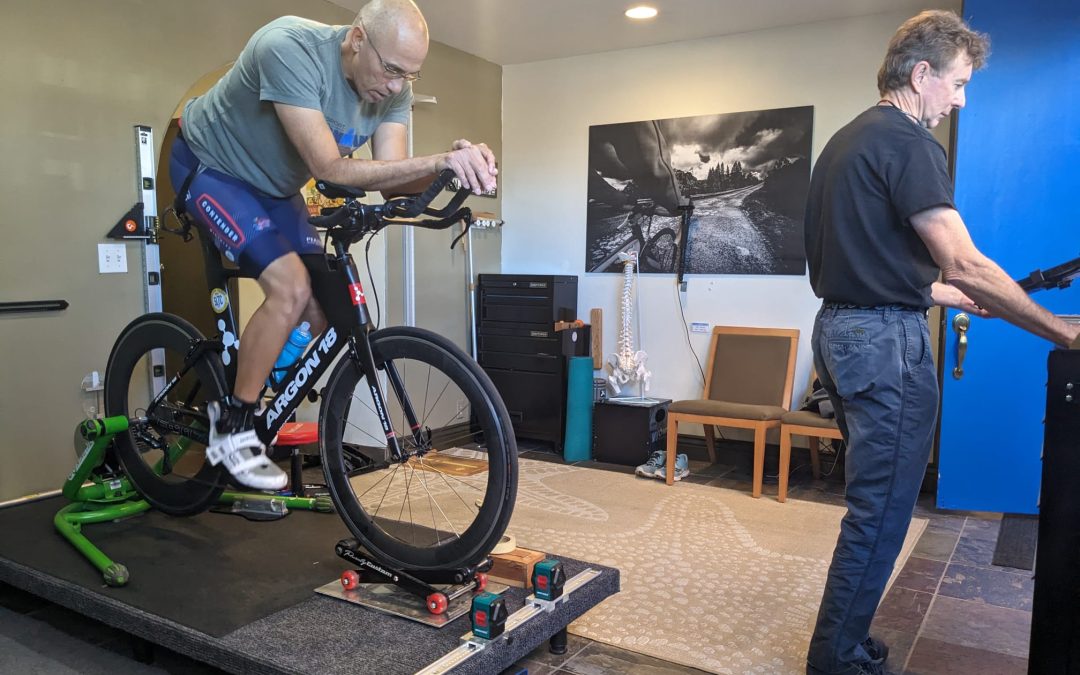
Fit bike test using adjustable sizing crank: The best way to convince a cyclist that a shorter crank length would be beneficial is to allow them to feel the difference. This is most easily done on a Fit Bike equipped with an adjustable crank, enabling different lengths to be evaluated in quick succession. The response from the cyclist when trying a more suitable crank length is usually immediate and pronounced. The decision is made and you may rest your case. Unless you or the rider want to confirm this with normal riding outside.
Rider’s own bike using an adjustable sizing crank: As an alternative or complement to the above method, a bike fitter can install a rideable adjustable crank for the cyclist to test on their own bike under their normal riding conditions, and make self-adjustments to test different lengths. This is possible with the Croder Spirit Crank Fitter tool.
Are There Downsides to a Shorter Crank?
There can be. A shorter crank often results in an adjustment to the saddle height, to maintain a suitable leg extension. A higher saddle height relative to the bottom bracket of the bike raises the center of mass of the rider, potentially decreasing stability as well as the ability to put a foot down at stops. Bike designers should consider lowering the bottom bracket to account for shorter cranks, especially on smaller frame sizes.
A higher saddle means more saddle to bar drop. Hence the bars may need raising in order to maintain the saddle to bar relationship. Increasing the handlebar stack may be limited by the underling frame stack, steerer tube length, headset spacer options, stem design, and cabling.
Overall the positives outweigh the negatives, and the negatives could be addressed by the underlying frame design that takes into account the most likely crank length of the user of a particular frame size.
Case Study
Lauren came in for a bike fit on her road bike, and our fitter assessed her seat as being too high and lowered it as part of a number of changes. Following the fit she reported a lot of positives but one negative – an increased discomfort in the hip on one side. Although the lower seat height was better for her pedaling function through the power stroke and at full extension, it compromised hip function due to increased hip flexion at the top of the pedal stroke. This had been a persistent niggle but the lower saddle height brought it to the fore.
A few facts about Lauren. Height: 151cm, or about 5’0″. Inseam length: 72.8cm. Bike size: 44cm. Current crank length: 165mm – the shortest commonly available size when the bike was new.
Reviewing the information above, Lauren is at the lower end of the bell curve for inseam length, and looking at the chart, would do better on a length of 150 mm or below. Hip discomfort is a common symptom of a crank too long, especially in female riders. We put her on a fit bike with an adjustable crank and tested 155, 150, and 145 mm lengths. The reaction from her was immediate and priceless. I wish I had it on video. Much to her surprise 145mm felt the easiest, and 155mm still triggered some hip impingement. We then installed the Croder crank fitter on her own bike and showed her how to adjust the length. She did several short outside rides during the week and reported back that the 145mm crank length felt the best. She had no hip impingement and discomfort; could pedal at a cadence above 70rpm very easily, which previously was almost impossible, and felt much more at one with the bike. She was astonished that this is how riding must feel for riders with longer legs. Much easier than what she was used to. This experience provided the green light to order and install a 145mm crankset.

More Reading
Many thanks to Professor Jim Martin for his multiple research papers and presentations on crank length, and to cycling coach and bike fitter Rick Schultz for his strong advocacy in bringing the importance of crank length to the attention of bike fitters. You can find more about crank arm length from these people and others here:
Jim Martin
Rick Schultz
- https://lermagazine.com/article/at-all-levels-and-categories-of-cycling-correct-poor-crank-arm-fit-to-relieve-chronic-knee-and-hip-pain
- https://lermagazine.com/cover_story/a-perfect-bike-fit-starts-with-the-correct-crank-arm-length
Matt Appleman
https://www.applemanbicycles.com/resources/riders-guide-to-crank-length/
Media Coverage







Why does the chart for recommended crank length based off of inseam not include 172.5mm cranks? I see they are only listing 5mm increments, but what would the recommended range be for the most common crank length?
Hi Bri, I intentionally left out 172.5 from the chart to help make the point that despite it being the most common length I don’t think it is the most optimal length for many. To answer your question of what inseam length range it is suitable for, I would suggest an inseam length of 88cm – 90cm.
Switched from 165mm to 145mm crank now, but feel climbing becomes difficult. Does it mean the gears need to update for the shorter crank?
If by difficult you mean it is harder to push uphill, you may need lower gearing. Depending on the bike that may mean smaller chainring(s) at the front or a larger range cassette at the rear.
165 to 145 is a big change, and you will have lost some leverage which probably needs counteracting with different gearing.
Hi John,
Fabulous write-up. I appreciate the citations and examples too.
Perhaps an obvious answer to my lingering question: is inseam measurement taken with shoes off or on?
I’ve always been measuring my inseam with shoes off, but that puts my 5’9” / 29” inseam self at 73.66 cm and, therefore, at the bottom on your recommended range. That doesn’t seem right, as I don’t feel my proportions are that divergent from average male physiology.
What am I missing?
Cheers,
Christopher
Hi John, thanks for this very insightful information! My wife is 5″4′ and has an inseam of 29′ (73.7cm). When googling for the right crank arm length, I found websites suggesting to use the Obree / Machine / (low) Lennard Zinn methode, which result in 154.4 to 157mm. On this page you suggest 150mm or under for inseams under 75cm. Looking for crank arms in standard sizes, I mostly see 140, 152, 160mm. While I know it is kind of hard based only on inseam, would you suggest to try both the 140 and 152mm to find out what is most comfortable for my wife? Many thanks! Matt
Hi Matt, From Shimano and Sram the shortest is 160mm. A number of other brands make shorter crank arms. I’ve never come across a 152mm size though. 155, 150, 145, and 140mm are typical sizes. The best way to have your wife try out different sizes is with a bike fitter who has a fit bike with an adjustable crank on it, or a fitter with the Croder Spirit Crank Fitter took, which gets installed on the cyclists bike to test crank length. Inseam length is just one of several factors influencing the most appropriate crank arm length. Some like longer, some like shorter. 140 is probably going to feel too short for your wife. 150 or 155 would likely be suitable choices, and more rider friendly than whatever her current crank arm length is.
John,
Update: I’m embarrassed to say that I had my inseam measured wrong. (I think I mixed up my wife’s or one of my kids’ measurements for mine). 77.5 cm is correct (or 82.5 with shoes and clips).
If going without shoes, I believe this suggests a trial of 155 cm cranks is recommended, according to your chart. Does that sound right?
Best,
Christopher
Hi Christopher, 155cm would be my default for someone with a 77cm or so inseam measurement, but I also have the luxury of having a couple of length-adjustable cranksets and have riders try out the inseam- based length as well as longer or shorter to see what they respond to best. A 77.5cm inseam (and yes – shoes off is correct) is super short for a male so if your measurement is correct you are relatively short in overall height and/or are very torso dominant (long trunk/short legs) for your height.
Hi FitKit,
Thank you for this in-depth information! I started riding about 7-8 years ago and have been having a hard time with one sided hip pain and occasional front left knee pain, which I did not have before cycling. I went to PT for years and it never seems to improve. I was told I have tight hips. I have been wondering about crank length for awhile now. I have had professional bike fits and even when raised by me, crank length was not an option for my fits. I ride a size 52 Trek Emonda with 170 cranks. I am 5’5” with a 31” inseam, (78.74cm) and an 39.37cm tibia and am a 50yo female. I am getting very caught up on whether to get 160s or 165s. Some formulas put me on 160 some on 165. I climb well and do not want to lose that ability. My cadence is about 83 for my rides. I have a 52/36 Shimano 12 speed on the front and just got an 11/34 (was 11/30) for the back but have yet to use the 34 yet and do not use my small ring in front often (rolling terrain). I do not want to have to switch my front gearing if possible. I ride with a “fast” group (21+) and want to be able to continue this without my left hip and knee hurting post ride, Does it make sense to make the 5mm jump to 165s just to go for the 160s? I have been following FitKit and purchased some of your products since I started cycling. Thank you!
Hi AS. I recommend going straight to 160mm, and not bother with 165mm. You have the classic symptoms of riding a crank too long, and the hip pain is not due to tight hips but due to joint loading. I’d keep the same front gearing. You turn over a quick cadence so obviously you can perform well on a bike with that cadence and speed. It’s possible you might need to increase the chainrings to a 53/39, but I’d start with the 52/36. By way of comparison I have an 88cm inseam and use 170mm cranks, and have used 165mm as well. For you, 165mm would not be a big enough difference to create the relief you are after.